
- All
- Product Name
- Product Keyword
- Product Model
- Product Summary
- Product Description
- Multi Field Search
 English

Views: 1 Author: Site Editor Publish Time: 2026-09-23 Origin: Site
PVC leather and microfiber leather are two popular synthetic materials widely used for car interior wrapping and renovation. Many auto modification shops and overseas buyers select materials only by touch and price. This often leads to after-sales troubles such as fading, hydrolysis, peeling, sticky surface and strong odor after installation.
PVC leather and microfiber leather have obvious differences in substrate structure, weather resistance, service life and application scenarios. Choosing the right material helps reduce rework and greatly improve the finished quality of car interiors. This article explains their differences, pros & cons and material selection guide.
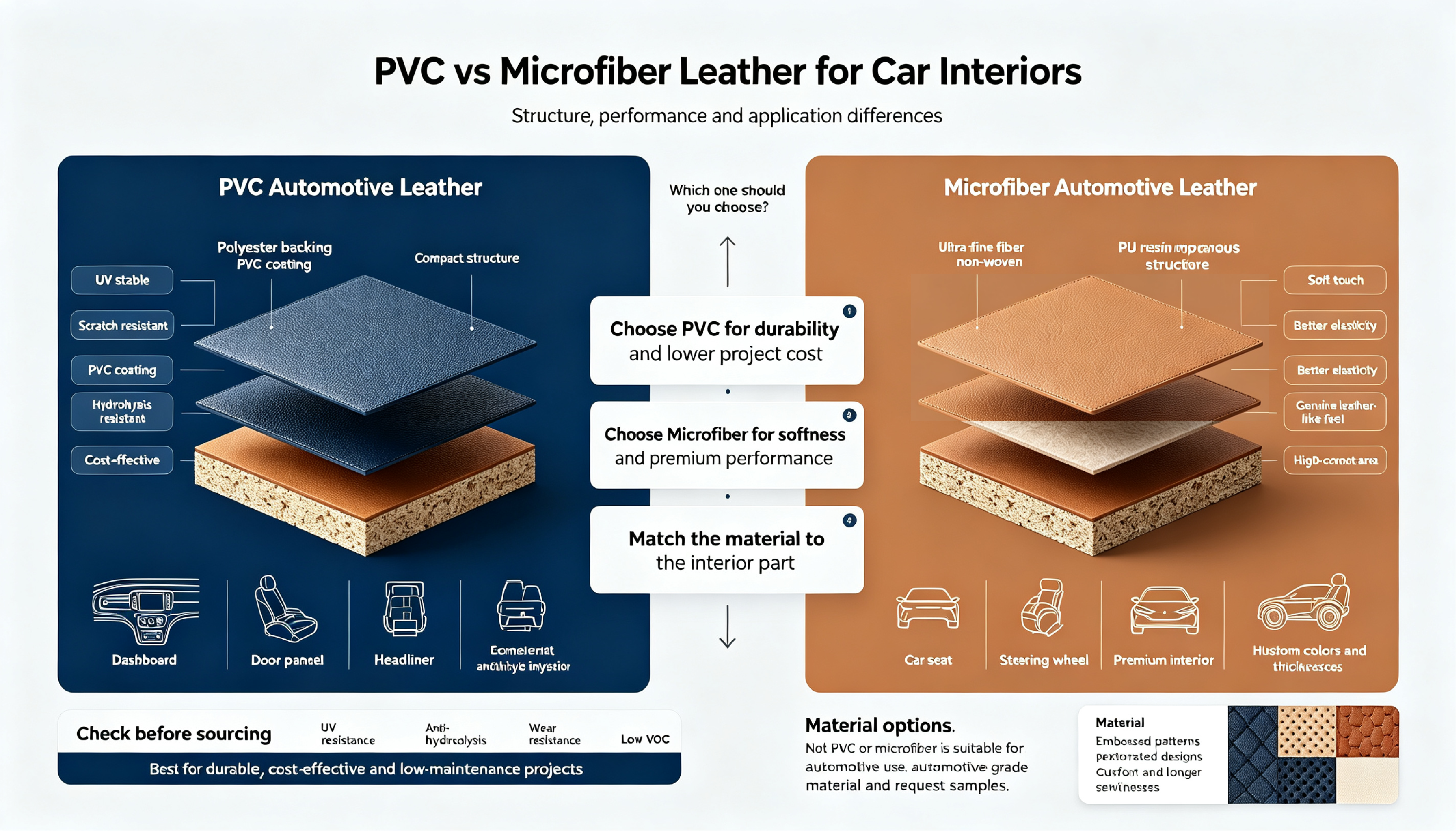
PVC Automotive Leather: Made of polyester base fabric coated with PVC layer. Mature and stable production process. The material is firm with great shaping ability and high surface hardness, scratch-resistant and cost-effective for interior wrapping.
Microfiber Automotive Leather: Made of ultra-fine fiber non-woven fabric impregnated with polyurethane resin. It has 3D fiber structure simulating genuine leather. It delivers soft and full hand feel similar to real leather, with physical properties comparable to genuine leather, classified as high-end synthetic upholstery material.
UV Resistance Modified PVC leather has stable UV resistance and resists fading under long-term sunlight exposure, suitable for dashboards and door panels. Automotive-grade microfiber leather with optimized formula features strong UV resistance and hardly powder under continuous sunshine.
Hydrolysis & Humid Heat Resistance High temperature, temperature change and humidity inside vehicles are major threats to upholstery leather. PVC leather has compact structure with good moisture-proof and anti-hydrolysis property, ideal for tropical rainy regions. Premium automotive microfiber leather has outstanding hydrolysis resistance, resisting delamination and cracking under long-term hot and humid conditions with longer service life.
Abrasion & Scratch Resistance PVC leather features hard surface and great scratch resistance, fit for frequently touched positions such as door panels and armrests. Microfiber leather has solid fiber structure with excellent wear resistance, hard to fuzz after repeated friction, ideal for seats and steering wheels.
Low VOC & Low Odor Low VOC is a standard requirement for modern car interiors. Inferior PVC or microfiber leather may have strong chemical smell. Our automotive-grade materials adopt low-odor formula with controlled VOC, reducing unpleasant odor inside the cabin for healthier riding experience.
✅ PVC Leather Dashboard, door panels, headliners, large-area wrapping and commercial vehicle interiors. Advantages: durable, shape-retaining, sun-proof, cost-effective and low after-sales risk.
✅ Microfiber Leather Private car seats, steering wheels and high-end interior renovation. Advantages: soft hand feel, genuine leather-like texture, excellent aging resistance, the top choice for premium modification projects.
Both PVC and microfiber leather support various surface treatments. We provide diverse embossed patterns and sport perforated styles for business, sport and vintage interior styles to upgrade the overall cabin texture.
Choose automotive-grade PVC leather if you need cost-effective, stable and durable material to control project budget. Choose automotive microfiber leather if you pursue genuine leather touch, long service life and premium interior appearance.
We supply high-performance automotive PVC leather and microfiber leather. Custom colors and thicknesses are available. Free samples and color charts can be provided for testing, for seat, dashboard, steering wheel and full car interior refurbishment & wrapping.


